








How many gels to take in a marathon according to your time
In a marathon, most runners need between 30 and 90 grams of carbohydrates per hour, depending on their pace and how well-trained their stomach is. Translated into gels: about 4 or 5 45-gram gels to finish in 3 h 30 at 60 g/h, or double that if your gel is one of the small 20-25 gram ones.
The exact figure depends on three things: how long you are going to take, how many grams your gel contains, and what your gut can tolerate while running. Let's break it down, with numbers you can keep handy on race day.

How many grams per hour: what science says
Asker Jeukendrup, one of the leading researchers in sports nutrition, summarizes the recommendations by duration of effort as follows (mysportscience, Recommendations for carb intake during exercise):
- From 1 to 2 hours: about 30 g per hour are probably enough.
- Up to 2.5 hours: increase intake with duration, up to 60 g per hour.
- More than 2.5 hours: up to 90 g per hour, provided it does not cause digestive problems.
An important nuance: above 60 grams per hour, the intestine does not absorb glucose alone anymore. To reach higher amounts, carbohydrate mixtures that use different transporters are needed, such as glucose and fructose together. And these high intakes are trained: the stomach adapts if you practice it on long runs.
How many gels according to your marathon time
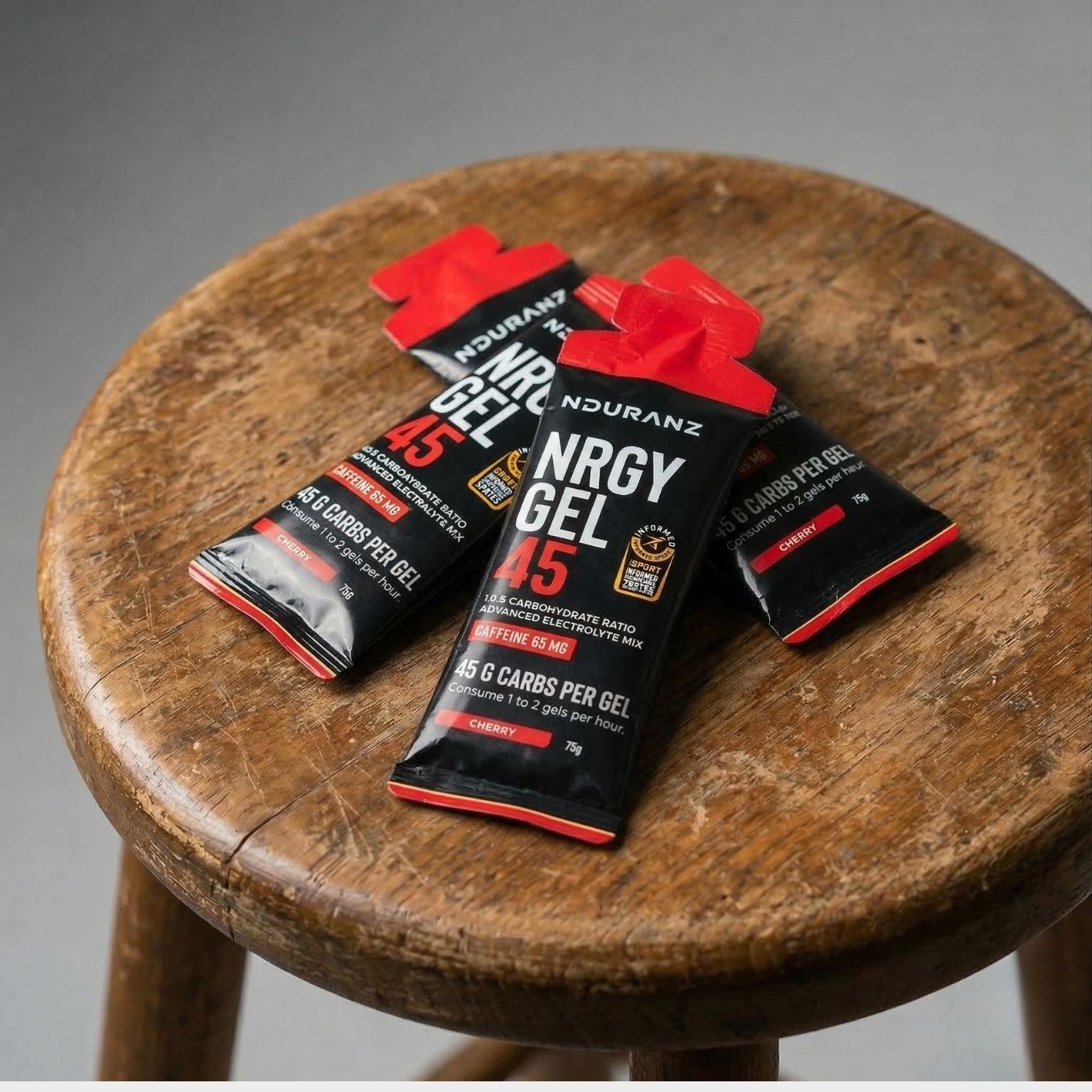
Multiply the grams per hour by the hours you are going to run. This table gives the total carbohydrates and their equivalent in 45-gram gels, which is the format of the Nrgy Gel 45:
- 3 h: 90 g at 30 g/h · 180 g at 60 g/h (4 gels) · 270 g at 90 g/h (6 gels).
- 3 h 30: 105 g · 210 g (4-5 gels) · 315 g (7 gels).
- 4 h: 120 g · 240 g (5-6 gels) · 360 g (8 gels).
- 4 h 30: 135 g · 270 g (6 gels) · 405 g (9 gels).
If your gels are 20-25 grams, multiply the gels by two. That is why many runners spread the intake between gels, isotonic drink from the aid stations, and some chewable format: carrying ten small gels in the belt is not practical.
If you run for less than 2 h 30, the reference drops to about 60 g/h as a ceiling. And if it is your first marathon, the realistic goal is usually in the 40-60 g/h range, well tolerated, rather than 90 g/h that you have never tried.

When to take each gel
There is no single rule, but there is a pattern that works for many people:
- Carbohydrate-rich breakfast 2-3 hours before the start.
- First gel between 30 and 45 minutes into the race, before you feel the slump.
- Afterwards, one every 20-40 minutes depending on your grams per hour goal and the size of the gel.
- Take it just before an aid station to accompany it with water. A concentrated gel without water is the classic recipe for flatulence and nausea.
Count the aid stations on the official route of your marathon and fit the gels with them. That plan, written down, is worth more than any feeling at kilometer 30.
With electrolytes, without them, or with caffeine
Gels differ by what accompanies the carbohydrates:
Without electrolytes. It lets you separate energy and salts. Useful if you already drink isotonic or take salt capsules and do not want to double the sodium. The Nrgy Gel 45 gel without electrolytes provides 45 g of carbohydrates with glucose and fructose in a 1:0.8 ratio, designed to improve absorption at high intakes.
With electrolytes. It solves energy and some of the salts in a single gesture. Practical on hot days or if you sweat a lot of salt.
With caffeine. Reserved for the second half or the final stretch, when fatigue bites. The Nrgy Gel 45 cherry contains 65 mg of caffeine per gel in addition to electrolytes. Try it before in training: caffeine tolerance varies greatly between people, and always respect the maximum daily dose indicated on the label.
If one more gel no longer fits, chewable formats are an alternative. The energy gummies with a 2:1 ratio from 4Endurance provide 20 g of carbohydrates per 25 g unit and do not melt in the pocket.

The most common mistakes
- Trying the gel for the first time on race day. Any new product is a digestive lottery. Try it in at least two long runs.
- Starting late. If you wait to feel the wall, you are too late: the gel takes time to make an effect.
- Taking gels without water. High concentration in the stomach, slow digestion, and discomfort.
- Copying someone else's strategy. A 2 h 45 runner and a 4 h 15 runner do not have the same plan.
This guide is indicative. If you have any digestive or metabolic condition, or are looking to fine-tune a lot, a sports dietitian-nutritionist will help you adjust the numbers to you. And if you are interested in how to organize training when you do not have a coach, we talk about it in the Ciclismo Serio episode training at 40 without a coach.
Frequently asked questions
How many gels should you take in a marathon?
It depends on the time and the size of the gel. At 60 g of carbohydrates per hour, a 3 h 30 runner needs about 210 g: 4 or 5 gels of 45 g, or 8-9 gels of 25 g, often combined with isotonic drink.
How often do you take a gel while running?
Usually the first one between 30 and 45 minutes and then one every 20-40 minutes, depending on the grams per hour you are looking for and the grams of each gel. Always with water.
How many gels for a half marathon?
For less than 1 h 30 many runners do not need any or take one. Between 1 h 30 and 2 h 30, one or two gels are usually enough to reach about 30-60 g per hour.
Can you take gels with caffeine in a marathon?
Yes, normally in the second half. Try them before in training and do not exceed the daily caffeine dose indicated by the manufacturer.
You have all the formats in our selection of energy gels for running and cycling, and in the Oviedo store we help you put together your aid station plan.



























Leave a comment
This site is protected by hCaptcha and the hCaptcha Privacy Policy and Terms of Service apply.